
Search Engine Optimization (SEO) for Family Law and Divorce Attorneys
Outsmart, don’t outspend your competitors: Increase new client leads on autopilot with this powerful SEO strategy.
When families face difficult transitions-divorce, custody battles, or adoption proceedings-they turn to Google first. Your potential clients are searching for answers at 2 AM, comparing attorneys during lunch breaks, and reading reviews before making the most important call of their lives.
The challenge? Nearly 90% of people never scroll past the first page of search results. If your family law practice isn’t visible where clients are looking, you’re essentially invisible to those who need your help most.
SEO for family law isn’t just about rankings-it’s about connecting with families during their most vulnerable moments and guiding them toward the legal support they desperately need. Done right, family law marketing through strategic SEO can transform your practice from a well-kept secret into the go-to resource for families in crisis.
This guide will walk you through every essential step to optimize your family law practice for search engines, from keyword research to conversion optimization. You’ll learn practical, actionable strategies that attorneys like you are using to attract more qualified consultations and build thriving practices.
How Family-Law Clients Search (and Why That Shapes Your SEO)
Understanding your clients’ search behavior is the foundation of effective SEO. Family law clients typically search in three distinct stages, each requiring a different approach:
Crisis Stage: Immediate, emotional searches like “emergency custody order” or “how to file for divorce tomorrow.” These searchers need quick answers and clear next steps. They’re ready to act but need reassurance that you understand the urgency of their situation.
Research Stage: More detailed queries such as “child custody laws {State}” or “how much does divorce cost in {City}.” These potential clients are educating themselves and comparing options. They want comprehensive information and proof of your expertise.
Decision Stage: Specific searches like “{City} divorce attorney reviews” or “best family lawyer near me.” These searchers are ready to hire and are evaluating their final options based on reputation, location, and specialization.
Family law searchers also use distinct patterns that differ from other legal areas. They frequently combine emotional modifiers (“difficult divorce,” “contested custody”) with geographic terms (“{County} family court”). They ask questions (“what happens if I don’t pay child support?”) and seek specific guidance for their unique situations.
Trust signals matter more in family law than almost any other practice area. Searchers look for attorney credentials, client testimonials, and evidence of successful outcomes. They want to see that you’ve handled cases like theirs and achieved favorable results.
Doing Smart Keyword Research for Family Law
Strategic keyword research forms the backbone of successful family law SEO. Instead of guessing what clients search for, you’ll use data to identify the exact terms that drive qualified consultations.
Build Service-Page Targets
Start by mapping your core services to keyword opportunities:
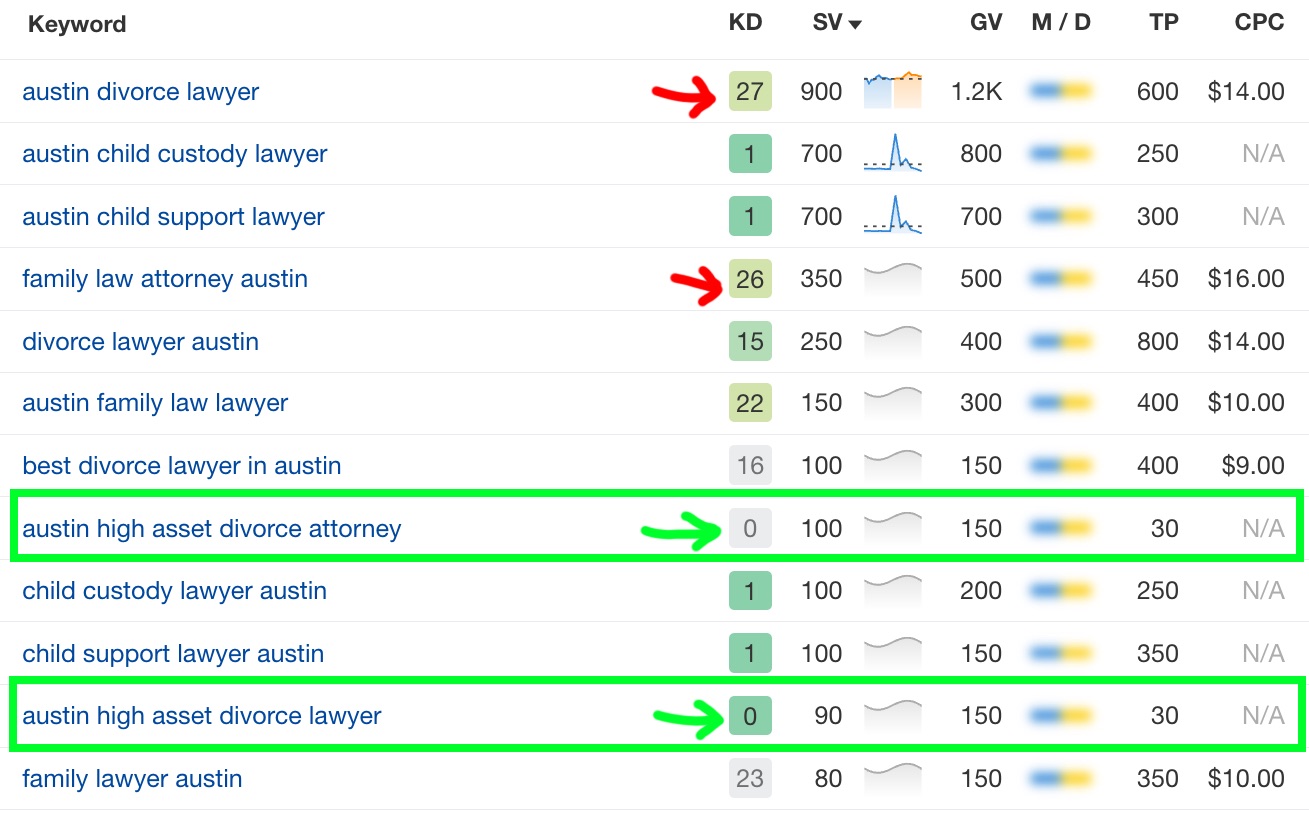
Divorce Services: Target “divorce lawyer {City}”, “uncontested divorce {State}”, “collaborative divorce attorney”, and “high asset divorce lawyer {City}”. Each service variation needs its own dedicated page.
Child Custody: Focus on “child custody attorney {City}”, “custody modification lawyer”, “emergency custody order {County}”, and “fathers rights attorney {State}”. Don’t overlook specific custody arrangements like “joint custody” or “supervised visitation.”
Child Support: Capture searches for “child support modification {City}”, “unpaid child support lawyer”, and “child support calculation {State}”. Include both enforcement and modification services.
Adoption: Target “adoption attorney {City}”, “stepparent adoption lawyer”, and “private adoption attorney {State}”. Different adoption types attract different searchers.
Mediation: Optimize for “divorce mediation {City}”, “family mediation services”, and “collaborative divorce {State}”. Many clients prefer alternative dispute resolution.
Capture Long-tail & “People Also Ask”
Long-tail keywords often convert better than broad terms because they capture specific intent. Use Google’s “People Also Ask” section and tools like AnswerThePublic to identify questions your potential clients are asking:
- “How long does divorce take in {State}?”
- “Can I get custody if I work full time?”
- “What happens to the house in a divorce?”
- “How much does a custody lawyer cost?”
- “Can grandparents get visitation rights in {State}?”
Create content that directly answers these questions. Each answer should be comprehensive enough to demonstrate your expertise while encouraging the reader to contact you for personalized guidance.
Map Keywords to Pages and Avoid Cannibalization
Create a simple keyword map to prevent your pages from competing against each other:
- Homepage: Brand name + “family law attorney {City}”
- Divorce page: “divorce lawyer {City}” + related divorce terms
- Custody page: “child custody attorney {City}” + custody variations
- Support page: “child support lawyer {City}” + support-related terms
- About/Bio page: “{Attorney Name} family lawyer” + credentials
- Blog posts: Long-tail questions and specific scenarios
Assign one primary keyword per page and 2-3 related secondary keywords. If multiple pages could rank for the same term, choose the most relevant page and ensure others link to it with descriptive anchor text.
On-Page SEO that Moves the Needle
On-page optimization is where keyword research meets user experience. Your goal is to create pages that both search engines and potential clients find valuable and trustworthy.
Titles, Meta, and Headers Examples
Craft titles that include location and service while staying within 60 characters:
Good: “{City} Divorce Lawyer | Experienced Family Attorney” Better: “Divorce Attorney {City} | Skilled Family Law Representation”
Meta descriptions should compel clicks while describing your value proposition in under 160 characters:
“Compassionate {City} divorce attorney with 15+ years helping families navigate complex divorces. Free consultation. Call (555) 123-4567 today.”
Structure your headers to guide readers through your content:
- H1: Primary keyword + location + value proposition
- H2: Service categories or key benefits
- H3: Specific services or common questions
Add FAQs + FAQ Schema
FAQ sections serve dual purposes: they answer common client questions and provide structured data opportunities. Include 5-7 frequently asked questions on each service page:
On your divorce page:
- “How long does the divorce process take in {State}?”
- “Do I need to prove fault to get divorced?”
- “How is property divided in a {State} divorce?”
- “Can I get alimony in {State}?”
Implement FAQ schema markup to increase your chances of appearing in featured snippets and voice search results.
UX that Converts
Your website’s user experience directly impacts both SEO rankings and conversion rates. Essential elements include:
Clear Call-to-Actions: Place phone numbers prominently in headers and enable click-to-call on mobile devices. Use action-oriented buttons like “Get Your Free Consultation” rather than generic “Contact Us.”
Mobile-First Design: Over 60% of legal searches happen on mobile devices. Ensure your site loads quickly, text is readable without zooming, and buttons are easy to tap.
Trust Indicators: Display attorney photos, credentials, certifications, and client testimonials prominently. Include your state bar number and years of experience.
Simple Navigation: Family law clients are often stressed and overwhelmed. Make it easy to find information with clear menu labels and logical page hierarchy.
Local SEO for Family Lawyers (Map Pack Wins)
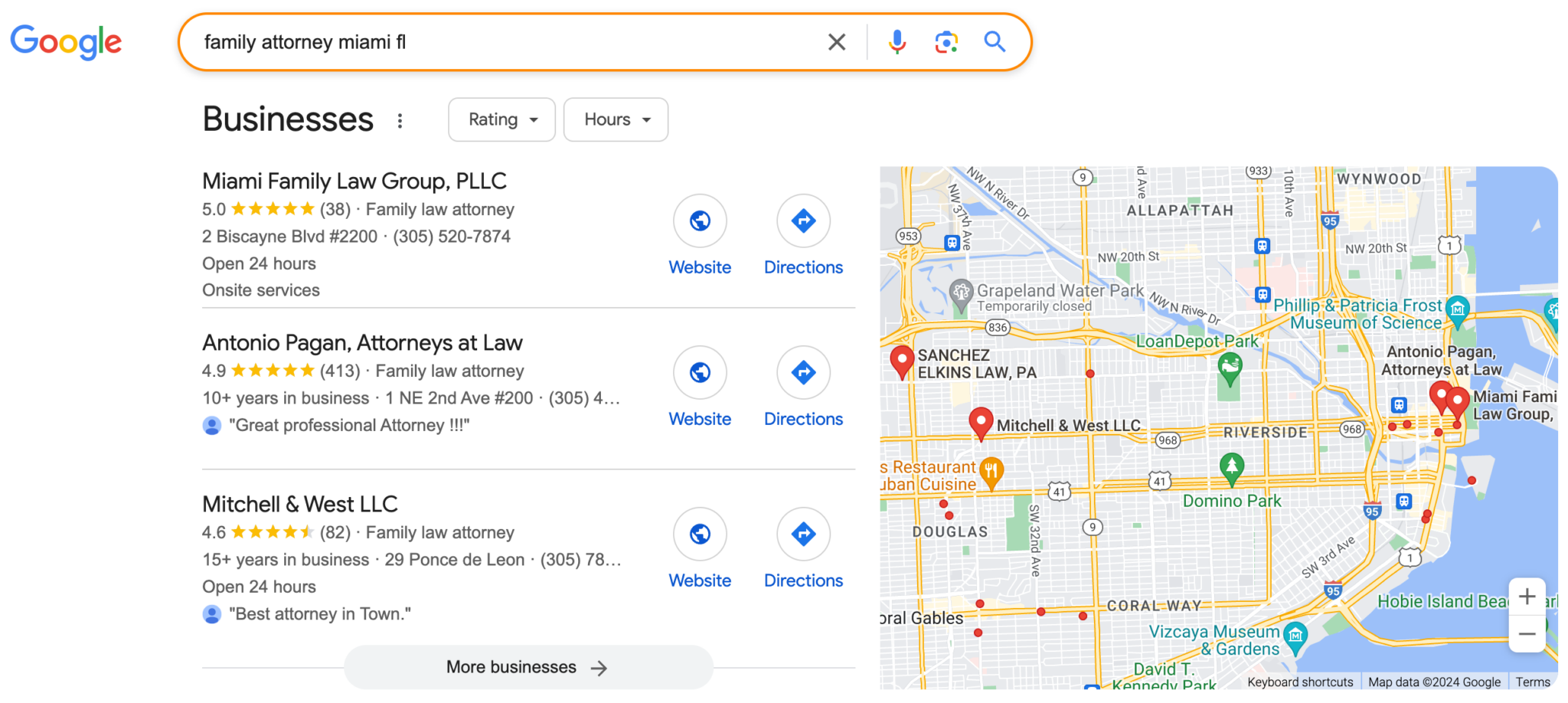
Local SEO is crucial for family law practices since clients typically prefer attorneys near them or familiar with their local courts. Appearing in the “map pack” (the three businesses shown with Google Maps results) can dramatically increase your visibility and calls.
Optimize Your Google Business Profile
Your Google Business Profile (GBP) is often the first impression potential clients have of your practice. Complete optimization includes:
Categories: Select “Family Law Attorney” as your primary category. Add secondary categories like “Divorce Lawyer,” “Child Custody Attorney,” or “Adoption Attorney” if relevant to your practice.
Description: Use your 750 characters wisely. Include your location, primary services, years of experience, and what makes you different: “Experienced {City} family law attorney specializing in divorce, custody, and child support. Serving {County} families for 15+ years with compassionate, results-driven representation.”
Photos: Upload professional photos of your office, staff, and yourself. Include images of your waiting area, conference rooms, and any community involvement. Update photos regularly to show your practice is active.
Posts: Share weekly updates about legal changes, community involvement, or helpful tips. Google Posts appear in your profile and demonstrate that your practice is active and engaged.
Reviews: Request Workflow + Response Best Practices
Reviews significantly impact local search rankings and client decisions. Develop a systematic approach to earning and managing reviews:
Request Script for Happy Clients: “I’m so glad we could help you through this difficult time. If you were satisfied with our service, would you mind sharing your experience in a Google review? It really helps other families find us when they need legal help. Here’s the link: [your GBP review URL]. Thank you!”
Response Strategy:
- Respond to all reviews within 48 hours
- Thank positive reviewers specifically
- Address negative reviews professionally and offer to discuss concerns offline
- Keep responses concise but personalized
Review Generation Tools: Implement a system to request reviews via email or text 2-3 weeks after case resolution, when clients are most satisfied but the experience is still fresh.
Citations & Legal Directories
Consistent business information across the web builds trust with both search engines and potential clients. Focus on these key directories:
Essential Legal Directories:
- Avvo (include detailed profile with practice areas and experience)
- Justia (comprehensive law firm listing)
- FindLaw (paid but high-value directory)
- Lawyers.com (Martindale-Hubbell)
- State and local bar association directories
NAP Consistency: Ensure your Name, Address, and Phone number are identical across all platforms. Even small variations (like “St.” vs “Street”) can confuse search engines and dilute your local SEO efforts.
Local Citations: Get listed in general business directories like Yelp, Yellow Pages, and Chamber of Commerce websites. Include industry-specific directories for family services or mediation if you offer those services.
City/County Practice-Area Pages
Create dedicated pages for each geographic area you serve, but only if you can provide substantial, unique content for each location:
Good Geographic Pages Include:
- Specific information about local courts and procedures
- Details about {County} family law requirements
- Information about local resources (counselors, child advocates, etc.)
- Genuine connections to the community
Avoid Thin Location Pages: Don’t create pages that simply replace {City} names without adding real value. Google penalizes low-quality location pages that don’t serve users.
Technical SEO Basics (So Clients Don’t Bounce)
Technical SEO ensures that search engines can easily crawl, understand, and index your website while providing a smooth experience for visitors. Poor technical performance can undermine even the best content and marketing efforts.
Mobile-First & Speed Checklist
With Google’s mobile-first indexing, your mobile site performance directly impacts all your rankings:
Page Speed Optimization:
- Optimize images: Use WebP format when possible and compress all images
- Enable browser caching: Allows returning visitors to load your site faster
- Minimize HTTP requests: Combine CSS and JavaScript files where possible
- Choose quality hosting: Invest in reliable, fast hosting specifically for law firms
Mobile Usability:
- Test touch targets: Ensure buttons and links are easily tappable
- Check text readability: No horizontal scrolling should be required
- Optimize forms: Make contact forms simple to complete on mobile devices
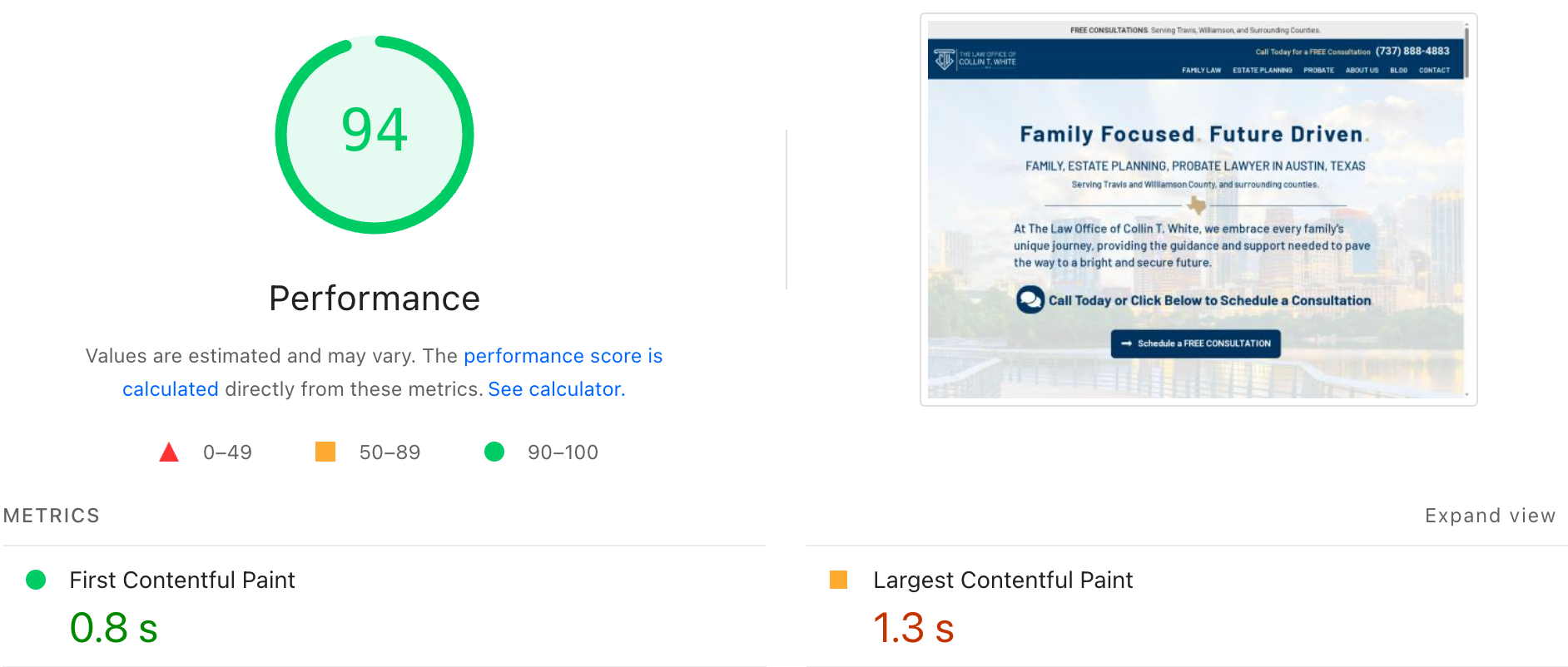
- Test loading speed: Pages should load in under 3 seconds on mobile networks
You can test your website’s page speed performance using the PageSpeed Insights tool for free.
Core Schema Markup
Schema markup helps search engines understand your content and can lead to rich snippets in search results. Priority schema types for family law practices:
LegalService Schema: Identifies your services to search engines Person Schema: Provides detailed information about individual attorneys FAQ Schema: Can trigger featured snippets for common questions Review Schema: Displays star ratings in search results LocalBusiness Schema: Essential for local SEO and map pack visibility
Accessibility & Trust Signals
Technical factors that build trust with both users and search engines:
Security: Implement HTTPS across your entire site. Clients entering sensitive information need assurance their data is protected.
Navigation: Create clear, logical site structure with breadcrumbs. Visitors should never be more than three clicks from important information.
Contact Information: Display your phone number, address, and contact form prominently on every page. Include multiple ways for clients to reach you.
Professional Design: Invest in a clean, modern design that reflects the professionalism clients expect from their attorney.
Content that Builds Authority (and Earns Links)
Content marketing for family law practices serves multiple SEO purposes: it demonstrates expertise, answers client questions, and attracts natural backlinks from other websites. Quality content also helps you rank for long-tail keywords that convert well.
Editorial Calendar: Service-Focused Content Ideas
Plan content around your core services and the questions clients commonly ask. Here are 6-8 content ideas for each major practice area:
Divorce Content:
- “How to Prepare Financially for Divorce in {State}”
- “Understanding {State} Property Division Laws”
- “Collaborative Divorce vs. Traditional Litigation: Which is Right for You?”
- “How to Tell Your Children About Divorce: A Guide for {State} Parents”
- “The Divorce Timeline: What to Expect in {County} Court”
- “Hidden Assets in Divorce: What to Look For”
Child Custody Content:
- “Best Interests of the Child Standard in {State}”
- “Creating a Custody Schedule That Works for Everyone”
- “How to Modify Custody Orders in {State}”
- “Parallel Parenting vs. Co-Parenting: Strategies for High-Conflict Situations”
- “Custody Rights for Unmarried Parents in {State}”
- “How Work Schedules Affect Custody Arrangements”
Child Support Content:
- “{State} Child Support Calculator: Understanding the Formula”
- “When Child Support Ends: Age and Circumstance Guidelines”
- “Enforcing Child Support Orders in {State}”
- “How Overtime and Bonuses Affect Child Support”
- “Child Support Modification: When and How to Request Changes”
Update content regularly to reflect changes in state laws and current court trends. Fresh, accurate information performs better in search results and builds trust with potential clients.
Linkable Assets & Digital PR
Create content that other websites naturally want to link to. This builds domain authority and improves your rankings across all pages:
Data-Driven Content: Survey local divorce rates, custody trends, or family law issues. Original data attracts links from journalists and bloggers.
Comprehensive Guides: Create definitive resources like “The Complete Guide to {State} Divorce Laws” or “Co-Parenting in {State}: A Comprehensive Resource.”
Local Resources: Develop lists of helpful resources for families, such as counseling services, financial planners, or child advocates in your area.
Legal Updates: Be first to explain new family law legislation or court rule changes in your state. Legal professionals and news outlets often link to clear explanations of complex legal changes.
Partnership & Guest Post Opportunities
Build relationships with complementary professionals and organizations:
Natural Partners:
- Marriage and family therapists
- Divorce financial planners
- Child psychologists
- Mediators and collaborative professionals
- Real estate agents (for divorce-related sales)
Content Collaboration Ideas:
- Co-author articles about the intersection of therapy and legal processes
- Provide legal context for therapist blogs about divorce
- Guest post on financial planning sites about property division
- Speak at local organization events and request links to your resources
Local Media Opportunities: Offer to provide expert commentary on family law issues in local news. Include links to relevant resources on your website.
Track What Matters and Iterate
Effective SEO requires consistent measurement and adjustment. Without tracking the right metrics, you can’t know whether your efforts are generating qualified leads or just vanity metrics.
KPIs: Focus on Business Impact
Track metrics that directly correlate with new client acquisition:
Lead Generation Metrics:
- Organic phone calls and form submissions
- Consultation requests from search traffic
- Email newsletter signups from content
- Downloaded resources (guides, checklists)
Visibility Metrics:
- Local pack appearances for target keywords
- Organic keyword rankings for core services
- Branded search volume growth
- Online review quantity and ratings
Engagement Quality:
- Time spent on service pages
- Bounce rate from search traffic
- Pages per session for organic visitors
- Return visitor percentage
GA & Search Console Quick Setup
Configure Google Analytics and Search Console to track meaningful data:
Google Analytics Setup:
- Set up goal tracking for phone calls, form submissions, and consultation requests
- Create segments for organic traffic vs. other sources
- Configure enhanced ecommerce if you sell any products or services online
- Set up custom dimensions for practice areas and geographic regions
Search Console Priorities:
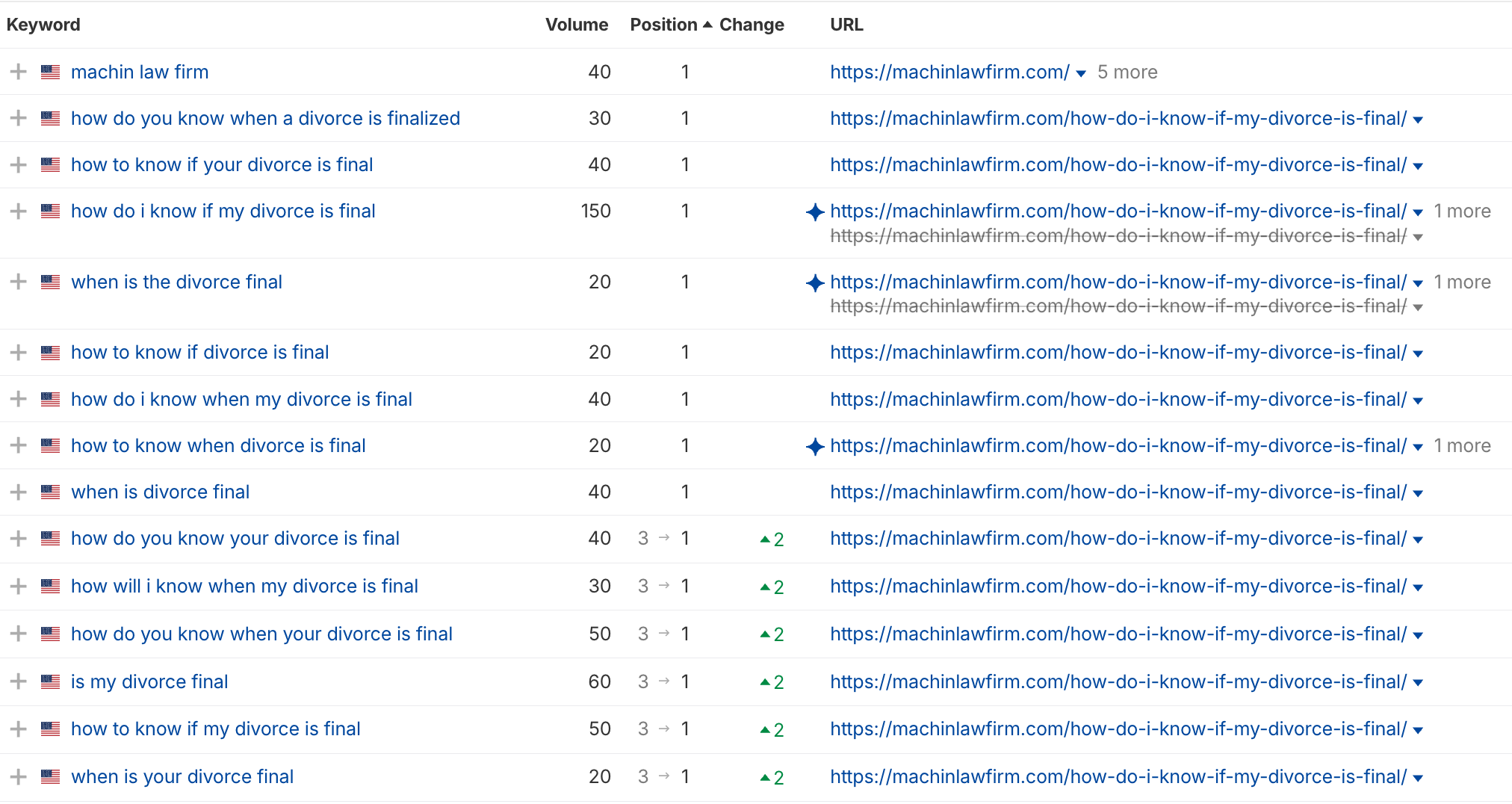
- Monitor which queries drive impressions and clicks
- Identify pages losing rankings and diagnose issues
- Track mobile usability problems
- Review internal linking opportunities
Monthly Review Process:
- Analyze which keywords drove qualified leads
- Identify top-performing content and expand similar topics
- Review technical issues and site performance
- Assess local search visibility and review management
- Plan content for the following month based on seasonal trends
When to Refresh, Consolidate, or Expand Content
Content maintenance is as important as content creation:
Refresh Signals:
- Declining rankings for previously successful pages
- Outdated legal information or law changes
- Low engagement rates compared to similar pages
- Competitor content significantly outperforming yours
Consolidation Opportunities:
- Multiple pages targeting similar keywords
- Thin content that could be combined into comprehensive resources
- Outdated pages with low traffic but valuable inbound links
Expansion Indicators:
- High-performing content with expansion opportunities
- New legal developments in your practice areas
- Seasonal content needs (custody during holidays, etc.)
- Gap analysis showing missing content for important keywords
Common Mistakes to Avoid (Quick Hits)
Learn from common SEO mistakes that can hurt family law practices:
Thin Service Pages: Don’t create pages with just a paragraph about each service. Provide comprehensive information that demonstrates expertise and answers client questions.
Keyword Stuffing: Using “divorce lawyer {City}” 20 times on one page hurts more than it helps. Write naturally and focus on providing value.
Duplicate City Pages: Creating nearly identical pages for every nearby city with minimal content changes can result in penalties. Only create location pages if you can add substantial unique value.
Slow Loading Sites: Family law clients are often stressed and impatient. If your site takes more than 3 seconds to load, many potential clients will leave before seeing your content.
Spammy Link Building: Buying links or participating in link schemes can result in severe penalties. Focus on earning links through valuable content and professional relationships.
Ignoring Mobile Users: Over 60% of family law searches happen on mobile devices. If your site isn’t mobile-optimized, you’re losing potential clients every day.
Inconsistent NAP Information: Having different addresses or phone numbers across various directories confuses search engines and potential clients.
Neglecting Google Business Profile: An incomplete or outdated GBP can cost you local search visibility and credibility with potential clients.
Next Steps & CTA
Implementing effective SEO for your family law practice doesn’t happen overnight, but following this systematic approach will set you on the right path:
Step 1: Foundation First – Complete your technical SEO audit, optimize your Google Business Profile, and ensure your website provides an excellent user experience on all devices.
Step 2: Content Strategy – Develop keyword-focused content for your core services and begin answering the questions your potential clients are asking online.
Step 3: Monitor and Optimize – Set up proper tracking, monitor your results monthly, and continuously refine your approach based on what generates qualified leads.
The attorneys who dominate family law search results didn’t get there by accident-they implemented strategic, consistent SEO practices that connect them with families in need of legal guidance.
Ready to transform your family law practice’s online presence? Our team specializes in helping family attorneys implement proven SEO strategies for lawyers that generate qualified consultations and grow sustainable practices.
Schedule your free SEO consultation today and discover how the right search optimization strategy can help you reach more families who need your expertise when they need it most.
Got Questions About Family Law SEO? We’ve Got Answers.
How long does it take to see results from family law SEO?
SEO is a long-term strategy. Most law firms begin seeing noticeable movement in 90-120 days, with significant results typically within 6-12 months – depending on your competition and market size.
Should I focus on local SEO or broader keyword targeting?
For most family law practices, local SEO should be the primary focus. Clients typically prefer attorneys familiar with local courts and procedures. Target broader keywords only after establishing strong local visibility, unless you handle cases statewide.
How often should I publish new content for my family law website?
Consistency matters more than frequency. Publishing one high-quality, comprehensive article every 2-3 weeks is more effective than posting thin content daily. Focus on thoroughly answering client questions and addressing specific legal scenarios.
What’s the most important SEO factor for family law websites?
While all SEO factors work together, local search optimization-particularly your Google Business Profile and online reviews-tends to have the most immediate impact on lead generation for family law practices. Most clients search locally first.
How do I handle SEO for sensitive family law topics?
Approach sensitive topics with empathy and professionalism. Focus on providing helpful, accurate information while respecting client privacy. Use general scenarios rather than specific case details, and emphasize your compassionate, client-centered approach.